Rights of accused priests still take priority over rights of accusers:

Latest from the Vatican on reporting accusations of child sexual abuse

Dr Michael Leahy has submitted the following article for publication. It explores some current issues around the reporting of Child Sexual Abuse. A review of Michael’s self-published book, Descending into Hell and Rising Again was printed in the Winter edition of The Swag.

In September 2024 a Letter of the Vatican Dicastery for Interpreting Sacred Texts repeated the church’s teaching that publication of the identity of priests accused, but not yet convicted by church or civil courts of paedophilia is an offence against charity. Even dead priests, the Letter asserts, are entitled to their good name until the courts find otherwise.

‘Transparency’ and ‘the right to know’, according to this teaching, are not justifications for publishing such names and details before judicial resolution of the cases. Clearly, the media would be covered by this ban. The exposure by the Australian media of so many such accusations that the Federal government established a Royal Commission into them would thus count as egregious offences against charity.

But there is nothing in the Letter to suggest that the ban would not also extend to others, even to victims. Since the priest who abused me never faced judicial proceedings of any kind, and is now dead, my publication of the details of my abuse in my recent book Descending into Hell and Rising Again (Leahy, M.T. 2025, self-published) would also violate this ban.

To the twenty-first century mind, it beggars belief that the Catholic church could persist in such a ban. This is the institution in whose structures a Royal Commission found ‘systemic’ causes of clerical child sexual abuse.

Despite these findings, and evidence of similar failings in the church throughout the world, the church persists in beginning its consideration of the legitimacy of publishing details of such accusations with an account of the rights of the accused priests: their rights under the principles of the ‘presumption of innocence’ and the ‘non-retroactivity of guilt’. The teaching – even in September 2024 – gives no consideration at all to the rights of their accusers!

The priority given by this teaching to the rights of the accused priests over those of their accusers is perhaps attributable to the teaching’s origins during the 19th century liberal assaults on the rights of the church in Europe. During that period false criminal accusations against priests were made as pretexts for expelling them from some countries.

However, persistence in this prioritisation in the 21st century in the light of the worldwide child sexual abuse scandal is an inexcusable failure by the church to adapt its teaching to the signs of the times. As a serious victim of abuse by a priest, the glaring failures that I see with this teaching are the following.

First, the Letter grounds this teaching in the demand of charity, yet it offers no account of the gospel norm of charity. Instead, it treats this defining feature of the Christian life as a simple moral precept.

No genuine understanding of the gospel norm of charity could countenance the rights of shepherds accused of sexual predation on their lambs over the rights of those lambs. The teaching of the church as expressed in the 2024 Letter, written in the light of a worldwide abuse crisis, is, however, impervious to the claims of those lambs even to the right to tell their stories.

Second, in denying that right, the teaching persists in ignoring the need and right of victims to the therapeutic relief of finally being able to tell their story and have it believed.

Third, the Letter’s use of the ground of charity to support its disqualification of the claims of ‘transparency’ trivialises the value of transparency. It is not just the reputations of the accused priests that are at stake here but also the trustworthiness of the authorities charged with preserving the unity of their communities. Transparency and the right to know are not just dubious rights claims from hostile liberal societies. They are rather the values whose observance enables their communities to continuously assess the trustworthiness of those who govern them.

Fourth, the church’s ban is so obviously self-serving that it is laughable. The only ones to benefit from its enforcement are the accused priests. Since the dead ones are no longer in a position to enjoy its benefits, the benefits would pass rather to the institution in whose names they ministered.

Fifth, the church itself acknowledges the ban’s unenforceability when a source document for the teaching – Pope Francis’ ‘Points for Reflection’ – calls for ‘collaboration with all persons of good will and with workers in the mass media to enable recognition and discernment of true from false cases, accusations from calumnies, avoiding rancour and insinuations, hearsay and defamation’ (n. 11). Such collaboration would be unnecessary if the ban were enforceable. Indeed, there is a touch of hypocrisy in insisting on the maintenance of the ban while at the same time urging collaboration with the efforts of those media attempting to circumvent it.

The inescapable conclusion of this assessment of the current teaching of the church on the legitimacy of publishing the identity, accusations and supporting evidence against priests/religious accused of child sexual abuse is that it is at best outdated, at present self-serving, and at odds with any tenable understanding of both the meaning of Christian charity according to the New Testament, and of the ethical implications of that meaning for the Christian community.
The Pope may inspire, but bishops decide

The following article by for Eureka Street by John Warhurst was written in the weeks following the death of Pope Francis.

Now is the time to turn our attention from Rome back to Australia. Australian Catholics, and indeed Australians in general, have had their eyes firmly fixed on the Vatican since the death of Pope Francis on Easter Monday. Vatican events have followed one after the other. Pope Leo XIV has now been elected and said his first public Mass. Our Governor-General and our Prime Minister have been in attendance in Rome at different times, as have many Australian bishops, media, lay faithful and tourists.

Our fixation with the shock and sadness, excitement and awe, in the Vatican has both symbolic and practical elements. It is symbolic in that we are proud that ‘our’ Pope attracts such enormous worldwide attention. Many of my friends of other faiths and none want to reflect on Francis and to learn more about Leo. Even my secular U3A current affairs class in Canberra has sought out a speaker on the new pope. It is practical in that the tenor of our Catholic lives is shaped by the universal church and by the emphases of the Pope of the day. Thus, our fixation is quite rational.

We know, however, that what the Pope sets out to do is not always what the Australian church ends up doing. Our day-to-day lives as Catholics are determined more directly by our diocesan bishop. We should be just as interested in their traits, gifts and special interests as we are in those of the Pope. Their character makes a great difference to the life of the local church. We know that such bishops are independent, make their own governance arrangements, and have varying levels of enthusiasm about the directions marked out by the Pope. That was obvious in Australia under Pope Francis. It will be the same under Pope Leo.

Yet it is hard to maintain a local interest given how such appointments come about. There is a connection, of course. Diocesan bishops worldwide are appointed by the Pope and that process has already begun again under Pope Leo after a short hiatus upon the death of Pope Francis.

This is a process Leo has been intimately involved with since 2023 when he was put in charge, as prefect, of the dicastery for bishops in Rome. This role gave him extra insights into the global church and may have contributed to him becoming pope. He is now signing off on appointments which have been in train in the dicastery while he was in charge. That may apply to some Australian appointees.

The appointment of diocesan bishops is an opaque and often tortuous process, conducted out of sight of most Catholics. The same is true of the papacy too, of course, though in this case we do at least know when the process is underway shortly after a pope dies.

The broad outline of the episcopal appointment process is known. The local Nuncio prepares a list of three names (known as a terna) which is then sent to Rome for higher-level processing. During the preparation in the local church, some tightly controlled consultation is undertaken in the diocese and across the country. Unfortunately, most Catholics never even know about it.

There have been calls to make the process more open to wider consultation, including greater participation by lay Catholics (without making it democratic in any sense). The Australian Plenary Council and the international Synod of Bishops on Synodality have both made such calls recently.

So far suggested reforms have come to little as far as I know, though the current Nuncio, Archbishop Charles Balvo, is known to be approachable and open to such wider consultation. Australian Catholics are fortunate in that regard. Balvo has put out the welcome mat in Canberra to those wishing to share their thoughts about a particular appointment.

The local part of the appointment process begins when a diocesan bishop or archbishop reaches the age of 75 and submits their resignation to the Pope. After that it can take some years for a new appointment to be made.

There are currently several vacancies in Australian dioceses. Until this week, two of the country’s seven archdioceses, Brisbane and Hobart, were without a bishop, with Archbishops Mark Coleridge and Julian Porteous having reached the retirement age of 75 and submitting their resignations to the Pope. As of Wednesday, one of those vacancies has been filled: Bishop Shane Mackinlay, previously Bishop of Sandhurst, has been appointed the new Archbishop of Brisbane.

Australian Catholics, whatever their persuasion, should take an interest in these appointments, because to a greater or lesser degree they will make a difference to their church lives. Yet even in the archdioceses concerned, only a few Catholics take even a passing interest and many of those feel excluded. That is not surprising given the lack of transparency.

It is probably too late to be involved in these consultations if you haven’t yet been asked. But if we are serious about synodality and a greater voice for lay Catholics, we should recognise the significance of what is about to happen. Let us pray for now and watch out for the news when it comes. In the longer term, let’s do something positive about the process. ‘Whatever Pope Leo says or does, it will be these appointees and others who directly shape our Catholic lives in Australia.’ 

John Warhurst is an Emeritus Professor of Political Science at the Australian National University.

Science, the Iconoclast

The following article is the first in a two-part series submitted by Des Connolly, a retired school principal of St Catherine’s Primary School Gymea and Star of the Sea Primary School Miranda and parishioner of St Patrick’s Church Sutherland.

Eight years ago, I wrote an article for The Swag entitled “O. M. G. How You Have Changed Since I was a Boy”. It was a tongue-in-cheek attempt to chronicle how my image of God had changed over the course of my then 82 years of life experience. That Schuster’s Bible History image of an angry old man up in the clouds marking down the wrongs his creatures were doing below was typical of my early boyhood.

Now, eight years on, I feel compelled to extend and update that article. What has changed in that time? Well, it has become increasingly evident to me that we have entered what our recent Pope Francis repeatedly called “a change of epochs”. And the force I see as spear-heading this new epoch is the iconoclastic behemoth of science.

Discoveries, new understandings and breakthroughs are funnelling in from the many branches of science at an increasing and overwhelming rate. And there appears to be a widespread scramble to keep up with the developments let alone understand their consequences and ramifications.

Across the science spectrum from the micro world of Quantum Mechanics to the macro world of Cosmology, science is challenging ethical, moral, theological and philosophical views and debunking many ideas and beliefs. It is a new world that says not only is the world stranger than we think, it is stranger than we can think.

Just a few years ago three scientists (Alain Aspect, John Clauser, Anton Zellinger) were awarded the Nobel prize for their work in the Quantum realm proving that pairs of sub-atomic particles are able to “communicate” with each other instantaneously, no matter the distance. This disproved something Einstein said could not happen. He called it “spooky action at a distance” that would require something travelling faster than the speed of light. And already this “entanglement” discovery is being applied in computer technology.

Staying with the micro world, one has to marvel at what is unfolding in the Quantum computer field. Here, scientists tell us that these revolutionary machines, that utilise the reason-negating fact that a particle can be in multiple places at any one given moment, will operate at a speed and capacity a million times beyond present computers. Interestingly, two Australian computer scientists have shunned offers to work overseas and are well on the way to producing this machine here in Australia. They are confident it will happen in the next few years and say that such a device will have more capability than all of the present computers in the world put together. What a shattering moment that will be!

Then there is the fast-developing field of Artificial Intelligence (AI) which will be linked to Quantum computer development. Here, science has mapped out several stages of progress from simple automation to a creative, self-determining super brain. A recently developed AI model recorded an IQ of 160. This is 10 points higher than that of Einstein.

The leaders in this field assure us that AI is only in its early developmental stage and that based on the current trajectory, the development of that creative even “conscious” super brain is not far off.

Already at this infant stage, AI is being widely utilised in medicine, universities, commerce, etc. I am told even a creditable homily here and there has been produced this way. Obviously, the potential for this technology will be enormous, leading to revolutionary societal change. It is being likened to the introduction of electricity.

Now, moving the focus to the macro world I home in on the brilliant James Webb Telescope (JWT). This $10 billion marvel of scientific engineering sits in its sun-orbiting, neutral-gravity position 1.5 million kilometres from Earth beaming down exceptionally clear pictures that go back in time further than any previous telescope and almost to the Big Bang (13.8 billion years).

Capturing the world’s attention by making the frontier of space so readily accessible, the JWT continues to show
a spectacular panorama of the Cosmos with its two trillion galaxies, each containing up to a billion stars.

This is a BIG, BIG world. A numinous, mystical world. A world whose dimensions and numbers alone are so incomprehensible we can only respond with wonder and awe. Here we are reminded that light, the fastest entity known, could zip around our earth 7.5 times in one second but would take 100,000 years just to cross our Milky Way galaxy and 2.5 million years to reach Andromeda, our nearest galaxy.

And just when cosmologists were feeling somewhat confident in the Big Bang theory the JWT delivers evidence of oddities regarding some stars and galaxies that do not fit this understanding.

This has sparked speculation that the Big Bang is just one of a continuous (eternal) series of such events. Other serious speculation has been about multiple universes, all with their own different physical laws.

Part Two of Des Connolly’s article will appear in the Summer edition of  The Swag.

Fragility and tenderness: Pope Francis’s final chapter

Pope Francis

Tributes to Pope Francis: The following articles were written by Mike Lewis and Gerard O’Connell on March 13 this year to mark the 12th Anniversary of the election of Pope Francis as the 265th successor of St. Peter. As he entered the 13th year of his ministry as Bishop of Rome, Francis was not in the Vatican, but was instead a patient in Rome’s Gemelli Hospital.

Twelve years. What a ride it has been. Pope Francis has been an earthquake in the Church. Trusting in the Holy Spirit, he has boldly led the People of God on a path towards necessary conversion, reform, and repentance. He’s far from perfect, and has met with great resistance, but there is no stepping back from the course he has set.

Elected at the age of 76, the length of Francis’s papacy has surpassed that of over 200 of his 265 predecessors. (I’ll leave figuring out the exact number to others.)

I am grateful that he is still with us. I am grateful for everything he has done to help me and so many others grow in faith. What a blessing he has been. This is a Jubilee year, and this pope still has much to teach us.

Two veteran journalists working in the Vatican, Andrea Tornielli of the Communications Dicastery and Gianni Valente of Agenzia Fides have both written in recent days about an emerging theme of Pope Francis’s papacy: fragility.

Tornielli: Twelve years ago, the then Cardinal Bergoglio addressed the General Congregations, quoting Henri De Lubac’s opinion that “the worst evil” the Church can incur is “spiritual worldliness”: The danger of a Church that “believes she has light of it’s own”, that counts on her own strength, her own strategies, her own efficiency, and thus ceases to be the “mysterium lunae”, that is, no longer reflecting the light of Another, no longer living and acting only by the grace of the One who said: “Without me you can do nothing”.

Remembering those words once again, today, we look with affection and hope at the windows of the tenth floor of Gemelli Hospital. We thank Pope Francis for this magisterium of fragility, for that still feeble voice of his that has joined the Rosary in St Peter’s Square in recent days – a fragile voice that continues to implore peace and not war, dialogue and not oppression, compassion and not indifference.

Valente: Embracing his fragility and weaknesses, with his body exhausted and never shying away from the work to which his vocation and ministry have called him, Pope Francis repeats without needing to use words what he has always proclaimed: the Church cannot be saved by a poor man, but by the grace of Christ, who guides, heals, and sustains her with His grace and His Spirit.

The human frailties of the Bishops of Rome do not disfigure the face of the Church; on the contrary, they reveal the mystery that keeps her alive and makes her journey in history.

Christ’s salvation embraces men and women just as they are, wounded by original sin, exposed to illness and falls, and this applies to everyone, beginning with the Successors of Peter. From Saint Peter to today, human frailty has never endangered the Church. Later in his piece, Valente reminds us that Pope Francis has never hidden his fragility and his humanity. Nathan Turowsky wrote a piece on that subject all the way back in 2020. Perhaps in this social media era it would be impossible to do otherwise.

Exposing our vulnerability, imperfections and fragility seems counterintuitive in a society where bravado and toxic masculinity are treated like survival skills. Certainly, virtues like humility and meekness are not the first things in most of our minds when we hear about violence and injustice. I must admit that expressions like “Revolution of Tenderness” are grating, at least initially.

Yet Pope Francis called for a Revolution of Tenderness in a 2017 TED Talk:

And what is tenderness? It is the love that comes close and becomes real. It is a movement that starts from our heart and reaches the eyes, the ears, and the hands. Tenderness means to use our eyes to see the other, our ears to hear
the other, to listen to the children, the poor, those who are afraid of the future. To listen also to the silent cry of our common home, of our sick and polluted earth. Tenderness means to use our hands and our heart to comfort the other, to take care of those in need.

Tenderness is the language of the young children, of those who need the other. A child’s love for Mum and Dad grows through their touch, their gaze, their voice, their tenderness. I like when I hear parents talk to their babies, adapting to the little child, sharing the same level of communication. This is tenderness: being on the same level as the other. God himself descended into Jesus to be on our level.

This is the same path the Good Samaritan took. This is the path that Jesus himself took. He lowered himself; he lived his entire human existence practicing the real, concrete language of love. Yes, tenderness is the path of choice for the strongest, most courageous men and women. Tenderness is not weakness; it is fortitude. It is the path of solidarity, the path of humility. Please, allow me to say it loud and clear: the more powerful you are, the more your actions will have an impact on people, the more responsible you are to act humbly. If you don’t, your power will ruin you, and you will ruin the other.

The message of the Gospel is one of mercy and forgiveness. We are all sinners. Life is more fragile than we think. Blessed are the peacemakers. Blessed are those who show tenderness. I don’t think there’s a single Catholic who has not been challenged in some way by Pope Francis’s teaching. I look forward to what he has to teach us in the next chapter of his papacy.

By Mike Lewis.

Twelve remarkable years:

A reflection on the Pontificate of Pope Francis and leading the Catholic Church from his hospital room

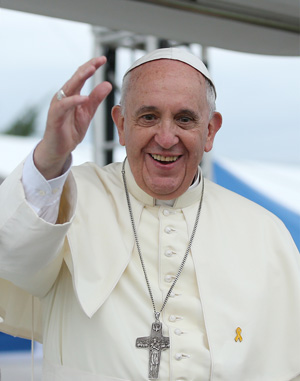
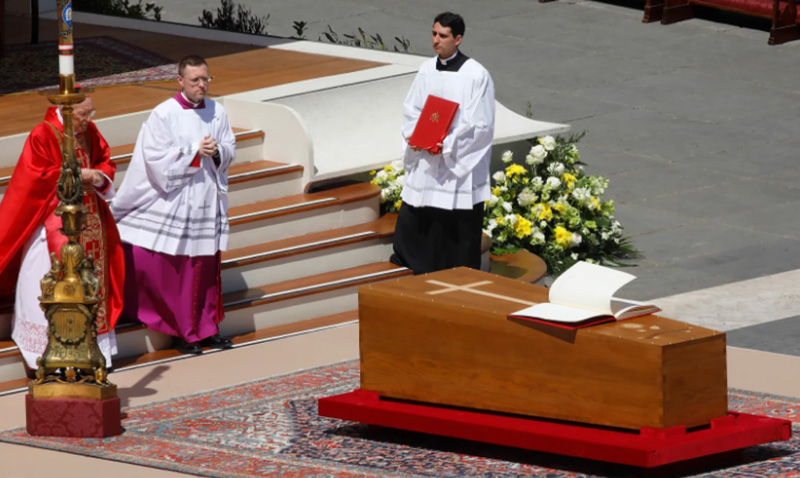
Pope Francis died on Easter Monday, April 21, 2025, at the age of 88 at his residence in the Vatican's Casa Santa Marta. Both articles were written prior to his death.

Cardinal Jorge Mario Bergoglio was the 76-year-old Jesuit Archbishop of Buenos Aires when 115 cardinals from 47 countries gathered in conclave voted to elect him pope on Wednesday afternoon, March 13, 2013. His surprise election caused a seismic shift in the Catholic Church with its 1.3 billion members and transferred the church’s leadership for the first time in history from Europe to Latin America, where nearly 40 percent of the world’s Catholics live.

When Cardinal Giovanni Battista Re, who was presiding over the conclave, asked if he would accept the election, Cardinal Bergoglio responded, “I am a great sinner, [but] trusting in the mercy and patience of God, in suffering, I accept!” And when asked by what name he wished to be called, he responded: Francesco (Francis). The name, after St. Francis of Assisi, indicated a program, the lodestar for his worldwide ministry.

One hour later, Pope Francis appeared on the central balcony of St. Peter’s Basilica and won the hearts of some 100,000 people from all continents gathered in St. Peter’s Square with his first greeting: “Fratelli e sorelle, buona sera!” (Brothers and sisters, good evening!). He astounded them again soon after when, breaking with tradition, before giving them his blessing, he asked them “to pray to the Lord that he will bless me: the prayer of the people asking the blessing for their bishop.”

That was the beginning of Francis’ revolution and reform of the papacy that has so changed the Catholic Church and its image in the world over the past 12 years. It began with a conversion of the papacy, as Francis eliminated many symbols of status and decided to live in a small apartment in the Santa Marta Vatican guesthouse instead of in the papal apartment of the apostolic palace.

The first Jesuit pope has sought to bring people close to Jesus, both by his deeds and words. His homilies explaining the Gospel have had a major impact, especially during the Covid-19 epidemic, as he spoke in a language that ordinary people understood. His gestures, like when he embraced the man with a badly disfigured face, have also made a great impact.

As pope, he has sought to change the mentality of those working in the Vatican before changing its structures. His pre-Christmas talks, aimed at this goal, resemble those of a director of the Spiritual Exercises. He has also insisted on taking the Roman Curia to a retreat centre outside of Rome for the same reasons. He has also changed the structures and priorities of the Roman Curia by introducing reforms in its new constitution, “Praedicate Evangelium” (“Preach the Gospel”), that put evangelization as the top priority.

From day one, Francis wanted a missionary church, and a mission-oriented Roman Curia, that would be at the service of both the pope and the bishops.

I remember when Francis met some 6,000 representatives of the world’s media (who had come to cover the conclave) in the Paul VI Audience Hall on March 16, 2013. He told us, “How I would like a church that is poor, and for the poor!” Following through on this over these past 12 years, he has put the poor at the heart of his ministry as pope, as he has reached out to the homeless, the victims of human trafficking and the world’s discarded people and went to the geographical and existential peripheries of the world. He did this especially on his 47 foreign journeys when he visited 67 countries, many of them war torn, including Iraq, the Democratic Republic of Congo, the Central African Republic, Myanmar, and South Sudan.

Last September, he continued going to the peripheries when he undertook an arduous 12-day journey to Indonesia, Papua New Guinea, Timor-Leste, and Singapore.

Even from his hospital bed, he has never ceased to be concerned at the plight of the Ukrainians, as Russian drones and missiles hit the country’s electrical power plants, and at the suffering of the Palestinians in Gaza. Last Sunday, he appealed for a stop to the violence and killings in Syria, whose people have suffered so much from almost 14 years of war. From the hospital, he remarked, “War even seems more absurd from here.”

As he enters his 13th year as pope, Francis stands tall as the moral authority in today’s world, a voice pleading for humanity, peace, and respect for the dignity of all people, irrespective of race, religion, or nationality.

For him, we are all God’s children, called to love and respect each other as brothers and sisters, as he stated so clearly in “Fratelli Tutti” (“Siblings All”).

It is a message hard to proclaim in an increasingly polarized world, where the rule of the strongest trumps the rule of international humanitarian law, but he continues trying to convince people to build a better world. His voice is needed even more today than when he was elected, given the dramatic situation we are facing.

As he looks ahead, Pope Francis will want to ensure that the synodal process, the most significant undertaking of his papacy, will continue to progress and to shape the future of the Catholic Church, with important consequences for the promotion of Christian unity. He approved the synod’s final document without changing anything and established study groups to respond to important topics that had emerged at the synod.

He now hopes that many, if not all, of these groups will bring him their conclusions by the end of June, to enable him to move another step forward with the synodal church.

On Dec. 24, 2024, Pope Francis opened the Jubilee Year, centred on the theme of hope. He called on believers to be “pilgrims of hope” in a polarized world and a world at war. Some 30 million people are expected in Rome during this Jubilee Year, which ends on Jan. 6, 2026.

As historical record shows, the presence of the pope is not an essential element of the Jubilee, since it is first and foremost a pilgrimage to the tombs of the apostles, St. Peter and Paul, and a passage through the Holy Doors to gain the Jubilee plenary indulgences that the pope has granted. Pilgrims, of course, were drawn to see the pope and receive his blessing.

But today, as in the past, popes are not always present for the entire period of the Jubilee Year. Indeed, Pope Clement VI was in exile in Avignon, France, for the entire duration of the Jubilee Year in 1350. On other occasions, the popes were out of Rome for many months during these years, and some were sick at certain moments.

Before this Jubilee Year, only once in the 700-year history of the Jubilee has one pope opened the Jubilee Year and another closed it: The Jubilee of 1700 was opened by Innocent XII and closed by Clement XI. Francis at 88 years of age, and according to the historical record (certainly for the second millennium), is said to be the third oldest pope to lead the church.

The oldest pope was Leo XIII (1810-1903), who died at the age of 93 years and 140 days; the second oldest was Celestine III (1106-98), who died at the age of 92.

By Gerard O’Connell.