A note on the afterlife

Fr Greg Moses, Nowra, NSW has submitted the following and prefaces his article with “I have had these thoughts since my time of studying in Leuven in the late ‘70’s. The present rendition was stimulated initially by the Israel Falou saga*, edited a bit since then. It is not concerned with whether or not there is an afterlife but what the afterlife might be like.

These thoughts on the afterlife are heavily influenced by the work of a ninth century Irish philosopher whom I first came to know about in Leuven, by the name of John the Scot or Johannes Scotus Eriugena, literally John Scot Born in Ireland, working at the time on the Continent, in the court of Charles the Bald. The word Scotia at this time included Ireland. Our lecturer at the time was Professor Carlos Steele.

According to John the Scot, in his major work, Periphyseon, at the end of time hell as a separate place will be no more. How do we know this? Because the Bible tells me so: in 1 Corinthians 15 where it says at the end of time God will be all in all. When God is all in all, there will be no room left for hell. It also fits with his overall view of everything coming out of God and going back into God, God as the Beginning, Middle and End of everything.

But what about all this talk about heaven and hell?  John the Scot’s solution to this is that while everyone will be in heaven, the Kingdom of Heaven come in its fullness, some people will enjoy being there more than others, and some people may not enjoy it at all.

For instance (my language), people who get their kicks through pushing themselves up by pushing other people down. Or by turning other people into objects sexual or otherwise for their own fulfilment and enjoyment, or whose holy Trinity in fact is I, Me and Myself. Or who just can’t stand living in the same place as Jews or Moslems or Christians or the poor the sick the blind and the lame or people of other races or tribes or colour or language, or miscellaneous ‘deployables’ for that matter, who also happen to be in heaven, etc.

Some people thus may find themselves totally kick-less so to speak, eternally frustrated in so far as their usual ways of operating don’t work anymore. This is after all God’s world.  Also, the company may not be at all to their liking. They are in heaven, but because of the way they have shaped themselves by their own free decisions it is not a place where they are at all comfortable or in any way at home. They are in heaven, at the end of time the only place there is, the only one left, but for some people being in that place could be like being in hell.

This after all is a kingdom of truth and joy, of justice love and peace, a gathering of people from every tribe and tongue and race and nation, in which there is neither Jew nor Greek, slave nor free, male nor female, no hurt nor harm on all God’s holy mountain. It is a place in which the people mentioned in the beatitudes for example will find themselves particularly happy.

So, the goal of life is not so much to get to heaven as to allow God’s all-inclusive and intense love and mercy and forgiveness, a love that will die for us, though the working of the Holy Spirit, to gradually transform us into the kinds of people who might possibly enjoy it when we get there!  What kind of people?

Well, for instance the kind described in the Sermon on the Mount or in all the parables, with guidance also from St Paul’s attempted application of the gospel to his communities in the second half of his letters or that of John or James.

There is thus a kind of objectivity to it, our lives do matter and what kind of people in God’s grace and mercy we are becoming.  Heaven is God’s world, not some individualistic consumerist paradise adapted to people’s personal wishes and desires. Nor is it something determined by public opinion or shifting community attitudes. Though what it actually is might still be up for debate.

This general view then gets filtered through the Catholic and Orthodox idea of purgatory but conceived by preference in what seems to be the Orthodox or Eastern Catholic manner as more like a hospital than a prison. It is, so to speak, a place where we get patched up after all the dramas of life some of them our own doing and prepared some more to enjoy heaven by our very immersion in the divine love. Or, in terms imaginatively adapted from one of the parables (Wedding Feast), it is a place where we get all washed up, all healed up, all dolled up on our way into the Feast!

We need to allow ourselves to be gotten to the point where we are not beyond hope, where love can still transform us, where love can still save us, where we can accept to be all washed up, all healed up, and to put on the freely available wedding garment. But love does not force.

The English philosopher of religion John Hick, in his book, Evil and the God of Love (originally published 1966), goes a step beyond this with a speculation that, given long enough, Love will have its way even with the most difficult of customers. God after all has all the time in the world and then some.

My own position on this is that, while this might well be an object of reasonable hope, I don’t think it is something that we can claim to know or take for granted.  Love does not force, and there is no accounting for human stubbornness and pride even when totally irrational, or for the ingrained nature of some kinds of evil.  Also, while definitely helpful, I don’t think it is necessary for the sake of Theodicy. I think the John the Scot inspired idea might in fact be enough for this: see below.

Getting back to the John the Scot from Ireland inspired idea: this then influences how we operate in the context of giving pastoral or spiritual guidance. The focus will be in discerning together with the individual or couple or group what is the best way to facilitate the journey of transformation of this individual or this couple or the members of this group in these circumstances into the kinds of people who might enjoy heaven when they get there, the realistic next step along their road. Or, in process relational terms, it is a matter of discerning the divine lure, which is always specific to individual circumstances.

Also, as stated above, even by itself this does effectively remove the doctrine of an eternal hell from the problem of theodicy, justifying God in the face of evil. At the end of time everyone is in heaven. It is not God’s fault that some people are not enjoying being there, and there is no reason to think that a Love that will die for us will ever give up in trying to transform them into people who will so enjoy it.

Even if this Love in a particular case is not being successful, God is doing all that a loving God can be expected to do or even could do consistent with the uncontrolling nature of Love. We hope very much that Love will eventually succeed, but that is what it is, a plausibly well-grounded hope. Coming at it from another angle, we are after all allowed to hope that at the end of time hell will be empty.

Finally, this view also gives an extra point to living and working and praying and longing for the Kingdom of God in this world. Our enjoyment of heaven when we get there emerges not so much as a reward for our work in the here and now but as more like a natural consequence of the way we are being formed by that very way of living. This is in addition to whatever fragile successes we may have.

We get ourselves ready for enjoying heaven precisely by being people who live and work and pray for the coming of the kingdom in the here and now. Or better, we are gotten to be ready for heaven precisely by allowing ourselves to be turned into such people in the here and now. If we are such people, when we get there we will be only too delighted. Heaven is not some opium of the people: it is the absolute stir to our social and ecological action, in spite of all its limitations, in this world.

Gregory James Moses, Nowra NSW (April 2025)


*The “Israel Folau saga” refers to the controversy surrounding the termination of Israel Folau’s contract with Rugby Australia due to his social media posts expressing his religious beliefs. Folau, a devout Christian, posted a message on social media stating that «hell awaits» certain groups, including homosexuals, unless they repent. This led to Rugby Australia terminating his contract, citing a breach of the Professional Players Code of Conduct.
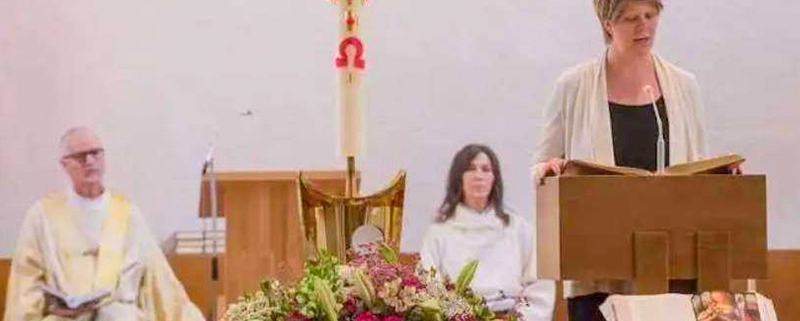
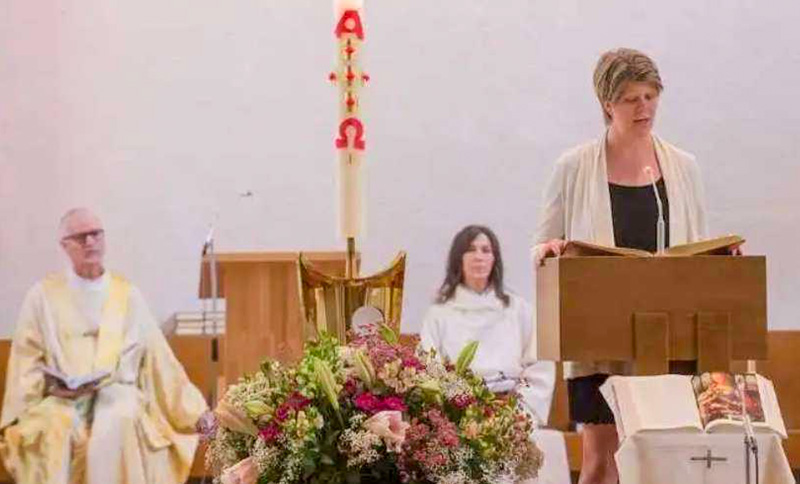
Lector: A vital but denied ministry

The following article by Michel Chambon was published in UCA News and was used as a basis for the formation at a recent meeting of the Council of Priests in Toowoomba Diocese. The author believes that, as an institution, we need to invest in the formation of men and women who help appreciate God’s plan and that being a lector is much more than simply reading aloud from sacred texts.

Serving the Church to move forward means clarifying how we distribute roles and responsibilities within our ecclesial communities. To continue my reflection on ministries in the Church in Asia, I would like to focus on another instituted ministry that is often neglected: that of the lector.

This is a ministry deeply connected with teaching, one of the three core functions of the Church. I received this ministry from the hands of a bishop, kneeling, during a quite formal Mass in Paris in May 2008. Yet, since that date, I have never encountered a Catholic community interested in it or even aware of what it might bring to the Church.

Within the Catholic Church, there is no desire for lectors. It is as if the Church wants priests and nothing else. However, the Second Vatican Council emphasized the importance of the plurality of ministries, including that of the lector, which is one of the six permanent and legitimate ministries in the Catholic tradition. But what exactly is a lector?

In its simplest sense, a lector is one who proclaims the Word of God. More fundamentally, the lector enlivens the Word within the Christian community and beyond. This can be manifested during liturgies by reading the Word of God, but it can also take countless other forms. The Word of God is not limited to written words in a sacred book.

Fundamentally, the Word-Logos is Christ himself – and it is revealed throughout the work of the Father and the Son. Thus, explaining nature, as the book of creation that sings its Creator, is also a way of being a lector. It only needs to be assumed as such – that is, as a mandate within the Church – to make the Word of God intelligible.

Being a teacher in our dioceses or schools to help people better appreciate the Word of God and engage with it as a life-giving message that gives meaning to existence can also be a way of living the ministry of lector.

Being a spiritual director who gives retreats and helps the faithful reread their lives in the light of Scripture, like Christ on the road to Emmaus, can also be a way of living the ministry of lector.

Being a journalist committed to telling the truth and fostering hope can also be a way of living out the ministry of lector. This only requires formal accompaniment, solid preparation, and liturgical institution by the local bishop.

In other words, being a lector is much more than simply reading aloud from sacred texts. Being a lector is far more than a temporary service offered by a devoted individual. Being an instituted lector is a permanent mission and a continuous responsibility. It involves bringing others into an understanding of the Holy Scriptures, and thus into the loving rationality of the divine plan.

This ministry is rooted primarily in the Holy Scriptures, but fundamentally, it is also rooted in what makes God’s action intelligible, whether in physics or palaeontology.

Yet, it should be clarified that being a lector is not the same as being a member of a particular religious order. The vocation of religious life is first and foremost to follow the charism of an order and a rule, often within a community setting. Monks, friars and nuns take solemn vows of poverty, obedience, and chastity – vows that do not apply to lectors.

Lectors are something different. They do not live in community, they do not embody a particular charisma, but they receive a formal and permanent mission. Along with instituted acolytes and catechists, they help us rediscover the full range of ministries and vocations within the Church.

In my personal case, I chose to live the ministry of lector by dedicating myself to studying and describing the Body of Christ, the Church. This Body also speaks to us of the intelligence of the divine plan. It whispers the meaning of faith. To study and explain this Body of Christ, I embarked on the academic path and, after many years, became an anthropologist and theologian. This is one way to be an instituted lector.

But the paradox is that the Church acts as if she does not need instituted lectors – instituted laypeople who live in the world alongside the entire ecclesial body. What the Church wants, above all, are priests to celebrate Mass and lead, not lectors to explain the intelligibility of the Word of God.

This paradoxical absence of instituted lectors within our ecclesial communities can be explained in many ways. Although often unspoken, there are both well-intentioned reasons and more questionable ones. On one hand, in our liturgies, there is often a desire to make space for all laypeople, and everyone is invited to read. So why designate specific people for this role? Sometimes, a temporary volunteer, serving for a few months, is preferred because she is someone who can be thanked and dismissed at will.

On the other hand, there is sometimes fear that giving permanent and formal responsibilities to laypeople will create more conflicts of authority. There is already enough difficulty managing tensions between priests, bishops, and permanent deacons, and for some people, it seems safer to limit the number of voices with permanent authority.

Another problem is training. Indeed, acquiring a real knowledge of the Holy Scriptures, biblical languages, and patristics – three essential fields for a true understanding of the Word of God – takes a great deal of time. Resources are needed to properly train potential candidates for the lectorate and then to evaluate whether their spiritual, psychological, and pastoral profiles correspond to the Church’s needs.

But often, no attempt is even made. We simply give up. There is a refusal to invest in long and complex ecclesial training programs that risk creating authority conflicts. When laypeople are trained, it is without formal responsibility at the end. These trained laypeople may become volunteers or temporary employees but not ministers. The training programs widely promoted by our dioceses are effectively capped by an invisible ceiling – a silent barrier that prevents many from gaining real responsibility but runs counter to the logic of synodality.

Yet the Church urgently needs men and women willing to dedicate themselves to the collective understanding of the Holy Scriptures, whether these are the sacred texts, the ecclesial body, or the great book of creation.

All speak to us of the Living God, His Logos, and the beauty of His plan for us. But this requires that we collectively provide the means to encourage, train, select, and regulate this type of ministers. Lectors aren’t going to just appear out of nowhere. As an institution, we need to invest in the formation of a broader professional body of ministers – men and women who help appreciate God’s plan.

Pope Leo XIV: What we know already (and what we can expect)

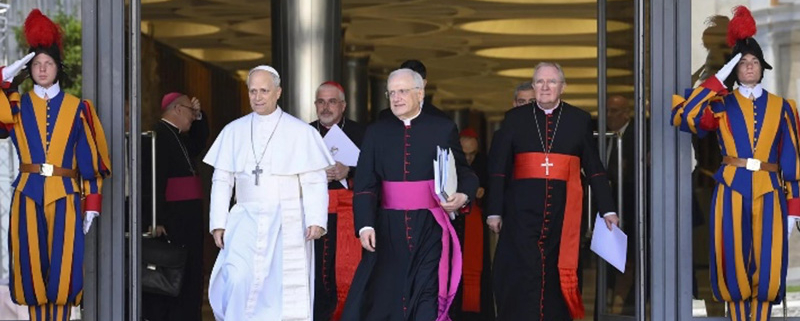
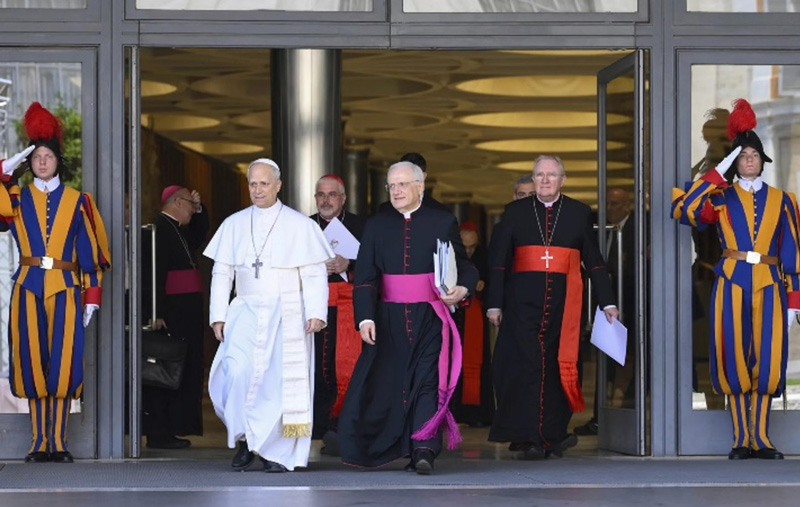
Pope Leo XIV, with Monsignor Leonardo Sapienza, walks out of the Vatican’s Synod Hall on May 10, 2025. (Credit: Vatican Media.)

A few weeks into the papacy of Leo XIV, contributing editor of Crux, Christopher R. Altieri penned the following reflection on what is important to the newly elected pontiff.

Born Robert Francis Prevost, the Augustinian missionary priest who served as prior general of his Augustinian order in Rome and was bishop of Chiclayo in Peru, came late to the Vatican – in 2023 – when the recently departed Pope Francis made him prefect of the Dicastery for Bishops and gave him the red hat.

There is little without precedent in the Catholic Church, but it is fair to say nothing exactly like this has happened before and safe to say it took Church watchers quite by surprise. Conventional wisdom had it that cardinals would not pick a fellow from the United States because it would combine the “soft power” of the papal office with the “hard power” of US political (economic, military, and cultural) clout in unhealthy ways. The concern was real, and not without precedent.

For most of the fourteenth century, the pope and eventually his whole court and government were removed to the French town of Avignon. The Avignon papacy began as an expedient arranged by the king of France – then the ascendant power in Europe – to break a deadlocked conclave. It quickly developed into what came to be known as the “Avignon Captivity” (and sometimes “Babylonian Captivity”) and lasted the better part of seven decades, from 1309-1376.

The fear had been, in essence, that bringing Avignon to the papacy would be as bad or worse than bringing the papacy to Avignon. The late Cardinal Francis George of Chicago has been widely quoted through the years as saying the election of a pope from the United States would not happen until the US enters political decline. Would-be readers of the signs of the times will now be wondering whether we have witnessed the jettison of that homespun wisdom or the fulfilment of a prophecy, or perhaps both.

What’s in a name? In any case, there’s a great deal in the name: Leo. The last Leo was Leo XIII, the father of Catholic Social Teaching in the modern era, who gave the Church and the world the seminal encyclical letter, Rerum Novarum, on the rights and duties of capital and labour, in the heady days of the industrial revolution.

Cardinal Ladislav Nemet, who dined with Pope Leo XIV on Thursday evening – the night of Leo’s election – told HRT Croatian Radio the pope is keenly sensible of the digital revolution unfolding in the 21st century.

“[Pope Leo] said that we are inside a new revolution,” Nemet said. “In Leo XIII’s time there was an industrial revolution going on,” Nemet said, “now there is a digital revolution going on.”

As Crux’s Charles Collins astutely noted in the days before the conclave, the media coverage – the reportage of cardinals’ remarks, the analysis, and the punditry – strongly suggested the cardinals would be asking themselves questions focused on the supposed conservative / liberal divide epitomized by debates over “traditional values” and Latin Masses on one side, or gay marriage and women clergy on the other.

In a word: The debates of the bottom half of the 20th century. “The first part of the 21st century sees a society questioning what it means to be human,” Collins wrote, “with ‘post-humanism’ being pushed by the leaders of many technology firms.”

If those early indications suggested the new pope agrees, Leo himself removed any possible lingering doubt when he addressed the whole College of Cardinals gathered in the New Synod Hall on Saturday morning.

“Pope Leo XIII, with the historic Encyclical Rerum Novarum, addressed the social question in the context of the first great industrial revolution,” Pope Leo XIV said.

“Today,” Leo continued, “the Church offers to all her treasure of social teaching in response to another industrial revolution and the developments of artificial intelligence.”

Much has been made of Pope Leo XIV’s service as a missionary priest and as a bishop in an impoverished part of the global south, as well as of his administrative leadership roles in both the Order of Saint Augustine of which he was prior general and in Rome as prefect of the Dicastery for Bishops.

All of that certainly played an important part in the cardinals’ discernment. That Leo XIV is a canonist of some repute is more important than one might think if one were to judge by the early commentary, especially in light of the state of law in the Church after Pope Francis. One of the criticisms levied by senior churchmen during the reign of Francis – often privately, but across the whole broad spectrum of opinion in the Church – was that Francis was not the most careful or orderly legislator ever to sit on the throne of Peter.

Pope Francis’s 2015 structural reform of marriage tribunals, for example, was not universally well received. Francis’s piecemeal reform of the Roman curia was long on theory but lacked the attention to practical detail as would put the Church’s central governing apparatus in form for 21st century action.

Pope Francis liked to issue legal decrees to solve particular problems. That way of going about things may or may not deal handily with the problem to hand but always tends to create difficulty down the line. Francis issued scores of Apostolic Letters motu proprio – on his own initiative – throughout his pontificate, at the rate of roughly five per year.

To give you some perspective: Pope St John Paul II issued thirty-one motu proprio in all the twenty-six years of his reign. Francis had topped that by the end of his fifth year in office and never really slowed the pace until the end.

The single most important legislative reform of the Francis pontificate was Vos estis lux mundi, a sweeping 2019 law that – on paper, at least – strengthened the process of investigating abuse and coverup allegations and provided a procedural framework for their judicial prosecution at Church law.

Pope Francis, whose own pontificate was bedevilled by cases of frequently alarming mismanagement, proved reluctant to use the law with any meaningful regularity or transparency. The cardinals knew going in, that the man they picked would have to put things in order.

Skeletons out of the closet

One thing observers noted almost immediately was that Leo XIV has an imperfect record on handling cases of abuse and coverup. Some of the accusations he has faced come from quarters highly questionable for their credibility and received a review that appears to have exonerated then-Cardinal Prevost.

One allegation of grave mismanagement appears to be well founded. That allegation is related to the case of Fr James Ray, an abuser-priest of the Archdiocese of Chicago. Then-Fr Prevost OSA, who was provincial head of the Augustinians in Chicago in the year 2000 allowed Ray – who had allegations against him and had been on restricted ministry for nearly a decade – to live (or did not prevent him from living) in a house belonging to his Order of Saint Augustine.

The Archdiocese of Chicago had reportedly noted the restrictions when they requested hospitality for Ray in the Augustinians’ house, which was situated very near an elementary school. Then-Fr Prevost apparently never alerted the school, nor caused the school to be alerted.

The episode with Ray, it is important to note, happened two years before the crisis of abuse and coverup exploded into global scandal. That eruption started in Boston in 2002, but it could have started almost anywhere. The scandal quickly engulfed the whole United States before it spread worldwide.

The crisis of abuse and coverup is not only part of the Church’s recent history but is of very long standing. It is certainly part of the Church’s present. One of the Church’s leading experts on the crisis, Jesuit Father Hans Zollner, has said we will not live to see the end of it.

“This will not be over in our lifetime,” Zollner said in March of 2019, “at least in countries where they have not yet started to talk about it.” The crisis was with us in the year 2000, but the scandal – and the awareness the scandal compelled – was only dimly on the horizon.

Prevost’s imperfect record on abuse may in fact be a sign of much belated awakening among the cardinals. It may demonstrate the cardinals – and the man they elected – finally understanding how abuse and coverup is a key issue, perhaps the key issue: They picked someone whose skeletons are out of the closet, which means they know he will be scrutinized and will have no excuse.

Read in that light, the election of Leo may actually be a sign they take the crisis seriously.

Is true crime turning victims into entertainment?

The recent guilty verdict in the Erin Patterson Trial along with other high profile cases in Australia and overseas has prompted Erica Cervini to offer the following reflection on the grief that such high profile public cases impacts the lives of victims through social media speculation and the proliferation of ‘True Crime’ podcasts. The article appeared in a recent edition of Eureka Street and is reprinted here with permission. 

It only took a few hours after the jury found Erin Patterson guilty of murder and attempted murder for us to learn that a cascade of books and TV shows would be written and made about the crimes that took place in a small Victorian town in 2023.

Erin Patterson murdered Gail Patterson, 70, Heather Wilkinson, 66, and Don Patterson, 70, and attempted to kill Ian Wilkinson, then 69, by feeding them death cap mushrooms.

The court case generated headlines around the world and then the entertainment frenzy began. Text Publishing announced that Helen Garner will collaborate with Chloe Hooper and Sarah Krasnostein to write The Mushroom Tapes: Conversations about a Triple Murder Trial. Allen & Unwin will publish Greg Haddrick’s book, The Mushroom Murders: A Family Lunch, Three Deaths, What Really Happened? and Hachette will publish writer and former detective Duncan McNab’s Recipe for Murder.

And, that’s just for starters. There are podcasts about the case, realms of articles written about it, including an Age story by a psychologist, who had never met Erin Patterson, providing her analysis on Patterson’s ‘narcissistic’ tendencies. ABC TV has announced a drama series Toxic, which will focus on Erin Patterson.

The ABC has also revealed on its website that a new comedy true crime panel show will examine real life famous cases. Comedian Julia Zemiro will host the show Crime Night! which airs later this year.

It remains to be seen if the Erin Patterson case will be fodder for the show that will ‘examine the fascinating real-life cases we’re all obsessed with in the funniest possible way’. True crime is a wildly popular genre, and some people are obsessed with it. There are academic studies why this is the case and why women are drawn to true crime.

But given the true crime frenzy about the Erin Patterson case, I’m drawn to the question of when true crime crosses the line and becomes puerile entertainment at the expense of the victims.

This has forced me to question why I have listened to some true crime podcasts. The discussion of true crime cases also raises legal questions for our court system. Mumbrella, an Australian news website that examines media and marketing, has pointed out that the Erin Patterson case unleashed an ‘unprecedented wave of legal rule breaking in both established and informal media’.

An episode of Media Watch details these media breaches. Organisations, including the ABC’s podcast about the court case, are accused of breaching suppression orders.

One of the first things journalism students learn when covering a court case is that they can only report on what is said in court. They also must abide by suppression orders and not comment on whether someone is guilty or not.

But when true crime morphs into a media and public frenzy – as in the Erin Patterson case – there’s a risk it undermines the tenet of a fair trial, muddies evidence with narrative, and places undue pressure on those tasked with delivering justice.

When I read the blurbs for the true crime books about the Erin Patterson case, I immediately felt uneasy. Two of the blurbs use breathless language to advertise the books and promise the reader ‘details not previously published’ and a ‘gripping’ read. The victims are merely characters in the books; not human beings and I suspect their feelings will be ignored.

When reading about the ABC’s TV drama Toxic I began thinking that the relatives and friends of the murdered trio Gail Patterson, Heather Wilkinson and Don Patterson, and Ian Wilkinson himself, won’t be able to distance themselves from the case. What effect would this have on their grief?

This question was laid bare after the recent death of Bradley John Murdoch who died in jail after spending more than 20 years there for the murder of Peter Falconio. ABC News Breakfast interviewed true crime author Robin Bowles, who wrote the 2020 book Dead Centre about the case in which she maintained that Murdoch was innocent.

I thought about Falconio’s family and friends and Joanne Lees, who was with Peter at the time of his murder. I can’t imagine what they were going through, particularly with Bowles once again casting doubt on the evidence Joanne gave to the police.

But it’s not just authors, podcasters, and TV and film makers who speculate what may have happened in true crime cases. With the advent of chat groups and sites dedicated to true crime the emergence of citizen sleuths is now a phenomenon. Many are having a detrimental impact on cases.

Take the Idaho murders in the US. In 2022, four university students, Ethan Chapin, Kaylee Goncalves, Xana Kernodle, and Madison Mogen, were found stabbed to death in a house. People set up Facebook pages and other online pages to speculate on who killed them. This caused a lot of pain according to a 2023 piece in The Atlantic: ‘The baseless – at times fanciful – speculation continued despite investigators’ repeated attempts to quell it. The rumours were adding chaos to their investigation, they said. They were bringing more trauma to people in mourning.’

Citizen sleuths are still at it trying to identify Jack the Ripper, who murdered five women in 1888 in Whitechapel in London. This case is a prime example of how a true crime commodifies the violent deaths of women and reduces them to a footnote in the story. Besides the books and films made about the case, tour guides are making money out of doing ‘death tours’ in the Spitalfields streets where the women were killed.

Hallie Rubenhold, a British historian and writer, wanted to counter the misinformation about the women murdered in her book, The Five: The Untold Lives of the Women Killed by Jack the Ripper.

In the introduction, she says she wrote the book because she wanted to restore the women’s dignity that was taken away by the murderer, and to debunk assumptions the media has made about their lives, just because they lived in some of the poorest areas in the Spitalfields.

‘The courses their lives took mirrored that of so many other women of the Victorian age and yet were so singular
in the way they ended.’ Rubenhold’s book is focused on the victims, not the murderer. There are some notable Australian podcasts that have done the same and have the consent of the victims’ families to broadcast information.

The Australian’sTeacher’s Pet’ podcast, hosted by journalist Hedley Thomas, is an example. Thomas investigated the 1982 disappearance of Lynette Dawson, a mother of two, from her home in Sydney. It can be argued that the podcast, which won the 2018 Gold Walkley, played a role in raising the profile of the case that led to Lynette’s husband, Chris Dawson, being found guilty of her murder in 2022. After the court case, Lynette’s brother Greg Simms thanked Thomas for ‘giving his sister a voice and helping clear her name’.

The true crime genre has a role to play when there is a reason to focus on the victims. However, so much of what passes as true crime underplays or even ignores the suffering of the victims and intrudes on their families and friends’ grief. It can encourage feverish speculation even after court verdicts and turn notorious murderers into cult personalities. Do you wrestle with your own ethics when you consume true crime?

Dr Erica Cervini is a freelance journalist and sessional academi.

Catholic Seminaries in Australia 1835-2023 (Part 8):

Vatican II and priestly formation

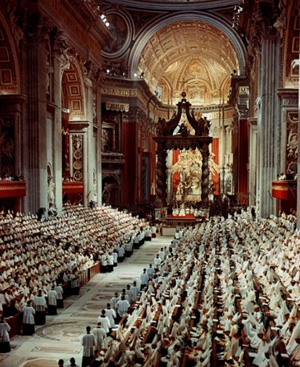
Second Vatican Council (1962-1965)

For some time now, The Swag has been publishing a series of articles submitted by Peter J. Wilkinson on the historical context of Australian Seminaries from 1835 – 2023. Part 8 in the series is published below: on Vatican II and priestly formation 

When Pope John XXIII announced the Second Vatican Council on 25 January 1959 priestly formation was always going to be on the agenda. Priestly celibacy, however, was not so clear. During the 1950s the Holy See was aware of a crisis in the priesthood as well as the significant decline in priestly vocations in most of Europe and Latin America. In 1962 Pope John XXIII was also concerned about what to do with priests who had abandoned the priesthood and were seeking laicisation.

When the Council opened in October three commissions were assigned to prepare texts for the Discipline of Clergy, Religious Orders, Seminaries, and Catholic Schools. The first draft On the Life and Ministry of Priests was presented at the 1964 Third Period and spoke of the priest’s call to holiness and the ideal of chastity.

This immediately raised the issue of celibacy, and a majority of the bishops called for a substantive revision.

At the 1965 Fourth Period, the Central Preparatory Commission discussed a short schema On Lapsed Priests which assumed that most defections were related to celibacy and opened with an uncompromising reaffirmation of this discipline. However, the Commission overwhelmingly agreed that the issue of celibacy should not be raised publicly, and Pope John XXIII removed the schema.

The Commission did, however, look to widening the grounds for dispensations to allow priests who had left ministry to marry, for Pope John XXIII wanted these priests to be reconciled with the Church. Pope John was also open to other priests wishing to be married to do so with the blessing of the Church. On his deathbed on 3 June 1963, he made known his regret at not having resolved the issue.

Pope Paul VI (1963 – 1978)

John XXIII’s successor, Pope Paul VI, was aware of Pope John’s deep concern for the priests who had left their priestly ministry to marry and his opposition to Conciliar discussion of celibacy. Paul VI also removed the subject of celibacy from discussion at Vatican II and in 1964, when increasing numbers of priests began seeking permission to marry, devised a ‘confidential’ judicial procedure to dispense them from celibacy and permit them to marry.

It was circulated to the Latin bishops in ‘strict secrecy’, but by 1965 had become widely known and many more priests began seeking the ‘Roman Rescript’ dispensation, as it was known at the time and later.

In November 1963, Paul VI published his Apostolic Letter Summi Dei Verbum commemorating the 400th Anniversary of the Council of Trent’s decrees on seminaries. He insisted that pastors and parents have a special duty to ‘direct their youth to the seminary ... as soon as they show clear signs of aspiring to the priesthood and are suited to it ... for only in this way will they be ... from the corruption of the world and enabled to cultivate the seed of the divine call in the most suitable surroundings’.

He said that seminary formation is ‘a complex work of physical, religious, moral and intellectual education’ and identified the indispensable signs of suitability for the priesthood as ‘right intention, solid piety, perfect purity of life, and sufficient knowledge’. But unless a bishop had ‘moral certitude’ that a candidate was suitable for priesthood, Paul VI said he should not ordain him.

The first draft on priestly formation De institutione Sacerdotali was presented to the Council’s full Assembly on 12 November 1964 but was sent back for amendment. The amended Decree Optatum totius was accepted and promulgated on 28 October 1965. It was the first of three decrees on the priesthood finalized in the Fourth Period, the others being Perfectae caritatis (Renewal of Religious Life) and Presbyterorum ordinis (Ministry and Life of Priests).

The Decree Optatum totius proclaimed the extreme importance of priestly formation but accepted that only ‘general rules’ (Ratio fundamentalis) could be legislated. It therefore called on the local Episcopal Conferences to draw up local programs for priestly formation (Ratio nationalis) suited to the time and place. They had to be approved by the Holy See, and revised at regular intervals.

The Council insisted that fostering vocations to the priesthood was a ‘community’ responsibility, including families, parishes, and teachers, with the bishop having a promotional role.

The ‘Roman Rescript’

The Council’s advice for minor seminaries was that the seminarians ‘should lead a life suited to the age, mentality, and developmental stage of young men, fully conform to the laws of a healthy psychology, be suitably involved in normal human activities, and have frequent contact with their families’. Their studies should be such that, should they leave the seminary, they will not be disadvantaged.

For major seminaries the Council insisted that the whole formation of these seminarians – who should have already completed courses in humanities and the sciences – should be preparation for the ministry of the Word, the ministry of worship and sanctification, and the ministry of a shepherd representing Christ before men. And every program must be joined with pastoral practice.

Seminary formators were to be selected from the best priests and painstakingly prepared. The bishop was to personally inspire them, and every priest should regard the seminary as ‘the heart of the diocese’. If individual dioceses were unable to have their own seminary, then regional or national seminaries should be established with statutes established by the relevant bishops and approved by the Holy See.

Spiritual formation was to be linked to doctrinal and pastoral training and no hardship of priestly life was to go unmentioned – especially celibacy, which was to be seen as a ‘precious gift’. Formation must also include the development of human maturity, attested by emotional stability, the ability to make considered decisions, a concern for justice, fidelity to one’s word, courtesy of manner, restraint, and kindliness in speech, and the entire program should be permeated with the cultivation of reverence, silence, and a concern for mutual help.

Other reforms proposed by Optatum totius were:

i) philosophy studies no longer to be limited to Thomistic Scholasticism;

ii) formation to adapt to contemporary pastoral needs, particularly those of the local church;

iii) training to be both doctrinal and pastoral;

iv) seminarians to use their own ingenuity;

v) Scripture to be the formative factor in the life of the student;

vi) seminaries to learn from modern sociology, psychology and pedagogy;

vii) seminarians to gain a better understanding  of other Christian churches and non-Christian religions;

viii) formation to be ‘genuine and deep’;

ix) the ablest and best-prepared men to be chosen for formation work; and

x) sufficient time for an intense spiritual apprenticeship to be given to seminarians to weigh their vocation maturely.

The Episcopal Conferences were also asked to prepare special post-ordination programs for their younger priests providing gradual introduction to priestly life and helping them to renew and develop that life daily.

Paul VI: celibacy and defections

On Holy Thursday 1966 Paul VI referred to priests resigning from ministry as ‘new Judases’, but at the same time flagged a more lenient attitude to dispensations.

After the Council Paul VI came under intense pressure to re-address the issue of priestly celibacy because it was ‘troubling consciences, perplexing some priests and young aspirants, and causing alarm among many Catholics’. In June 1967 he published his Encyclical Sacerdotalis caelibatus, firmly upholding the traditional Latin Church discipline of obligatory celibacy, emphasising that it was a ‘special gift’, and that ‘the grace of leading a celibate life will be readily granted by God if those who share the priesthood humbly and earnestly ask for it’. He did admit, however, that ‘the difficulties and problems which make the observance of chastity very painful or quite impossible for some, spring from a type of priestly formation which is no longer completely adequate for the formation of a personality worthy of a man of God.

He insisted that the formation program had to take account of the candidate’s physical and psychological state in guiding and orienting him toward the priestly ideal and harmoniously coordinate grace and nature in those with the proper conditions and qualifications. These should be ascertained as soon as signs of a vocation are first indicated, not hastily or superficially, but carefully, with the assistance and aid of a doctor or a competent psychologist. A serious investigation of hereditary factors should also be undertaken, and where candidates are found to be unfit for physical, psychological or moral reasons, formators have a grave duty to quickly remove them from the path to priesthood. Moreover, there must be a preliminary trial period before the observance of celibacy becomes definitive and permanent, and only where there is moral certainty that the maturity of the candidate is sufficiently guaranteed, should he be permitted to take on the burden of priestly chastity’.

When Paul spoke of the ‘lamentable defections’ of priests who were seeking laicisation by means of the Roman Rescript, he blamed those bishops who had inadequately and imprudently assessed their candidate’s suitability. But where there were grave reasons to doubt the full freedom and responsibility of the defecting priests, Paul was prepared, after careful judicial examination, to declare them unsuited and grant a dispensation from celibacy, but only when no other solution could be found.

He advised all bishops to stay closely united to their priests and give them and those preparing for the priesthood the ‘best part of your hearts and pastoral care’ by watching over their seminary education and helping them remain faithful to their vocation and duties. He urged bishops to leave nothing undone to foster among their priests and seminarians the ideal of consecrated celibacy, nor neglect those who have strayed, no matter where their painful odyssey had led them. Paul VI also asked the lay faithful to help their priests, encourage them to overcome their difficulties with fidelity, show them charity, extend warm friendship, and show deep respect.

In August 1967 Paul VI renamed the Sacred Congregation of Seminaries and Universities as the Congregation for Catholic Education with jurisdiction over seminaries.