A Jubilee “Tree” of Hope

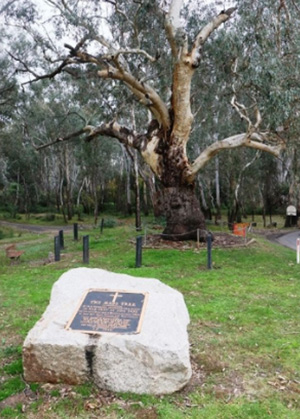
Peter Taylor, PP of Rutherglen and Chiltern writes: Over these past months I have given reflection time to a 600-year-old redgum tree, standing ever so strongly at Wahgunyah over the Murray River from Corowa.
In my present ministry at Rutherglen (mighty wine country!) with Chiltern and Wahgunyah, this tree is drawing pilgrims as a designated site of pilgrimage across our Sandhurst Diocese. Among other sites across Sandhurst, the Wahgunyah Mass Tree, as it is referred to, tells an interesting story.

For a start, the year 1869 saw the first Mass in the area, said by Very Rev. Dean Tierney, P.P. of Beechworth Mission. On a plaque near the Mass Tree are these words “Mrs. M.M. Burrows prepared the altar in her tent at this tree for the first Mass said in Wahgunyah about 1869 by Very Rev. Dean Tierney, P.P. Beechworth”. On the tree is a white cross and, in part, these words are also on the plaque; “That cross is such a simple thing, but of it men will talk and sing, it is a signboard on the road, to cheer man with his load ... such a simple thing yet it touches everything” AD 1946.

The plaque was unveiled in September 1946 by Pauline Nagle (aged 10), a great granddaughter of Margaret Mary Burrows, who, with her husband John arrived from Ireland in the 1850s and pitched their tent near the tree. It is recorded that John Burrows built a bark hut near the tree allowing Margaret to convert the tent into a chapel.

From recent times, the Mayor of Indigo Shire, Mr Bernard Gaffney, spoke of the importance of the Mass Tree ... “Back in 1869 when people from around the region came to Mass, they were full of love, faith and hope. For when you feel a bit low, you come to this tree, as I’m sure it will make you stronger”. (from a pictorial book in the Sacred Heart Church, Wahgunyah).

I bring this to you as a powerful presence of the Mass Tree standing ever so strongly despite nature’s floodings and bushfires over 600 years! A Jubilee Tree still giving hope from the best of intentions from Margaret and John Burrows.

Recently, pilgrims in their groupings have come to visit Wahgunyah, taking in the Mass Tree. If you journey to this part of Victoria, come over the bridge from Corowa, turn right at The River Fish & Chips (highly recommended) and drive down to the Mass Tree.

The Mass Tree stands today as a sign of hope and strength, offering the pilgrim in this year of Jubilee an encounter with Mother Nature, in God’s time over 600 years.

Submitted by Jim O’Toole.

More information on reference to Peter to Rot

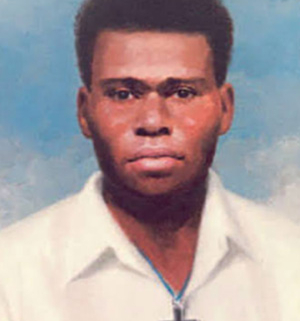
Peter to Rot

Further to an item published in the Winter edition, Peter Malone MSC contacted The Swag to add to the reporting on the impending canonisation of Peter to Rot in Papua New Guinea.

He writes, “I wondered whether you could make a note in the next issue concerning the item about the canonisation of Peter to Rot. At the end, there is comment on the work of the Divine Word Missionaries in PNG.

While I am happy to praise their important mission work, Peter to Rot lived and was martyred in Rabaul. In 1881, Leo XIII entrusted the missions
of New Guinea to the Missionaries of the Sacred Heart, one group arriving
in Papua, Yule Island, another arriving in Rabaul and continuing there, many of them imprisoned in Ramale Valley in World War II. In fact, the present Archbishop of Rabaul, Rochus Tatamai MSC, is a relation of Peter to Rot”.

Pope Leo speaks of generosity and love as the keys to fulfillment

Pope Leo XIV has urged the faithful to reflect on how they invest the “treasure” that is their life, challenging Catholics to share not only material possessions but also their skills, time and compassion for the good of others.

In a recent Angelus address, the Pope reflected on yesterday’s Gospel reading from Luke 12:32-48. The Pope emphasised that generosity and love are the keys to fulfilment, reminding the crowd that these gifts must be cultivated and put at the service of others, rather than hoarded or misused.

“Sell your possessions and give alms,” Jesus exhorts in the passage. Pope Leo made clear that this invitation extends beyond charitable donations, pressing his audience to offer their presence, love, and talents to those most in need.

“Everything in God’s plan that makes each of us a priceless and unrepeatable good must be cultivated and invested in order to grow. Otherwise, these gifts dry up and diminish in value,” he warned.

The pontiff’s remarks echoed the teachings of St Augustine, who Leo quoted verbatim: “What you give will certainly be transformed ... it isn’t gold, it isn’t silver, but eternal life that will come your way.”

Drawing on St John Paul II, Leo also emphasised the spiritual transformation that results from acts of mercy. Highlighting the example of the poor widow from Mark’s Gospel, Leo called works of mercy “the most secure and profitable bank” where believers can place their lives’ treasures.

The Pope also underscored the importance of vigilance in daily life – at home, parish, school, or workplace – encouraging all “to grow in the habit of being attentive, ready, and sensitive to one another.”

Source: CNA.

A Call for Climate Justice and the Common Home

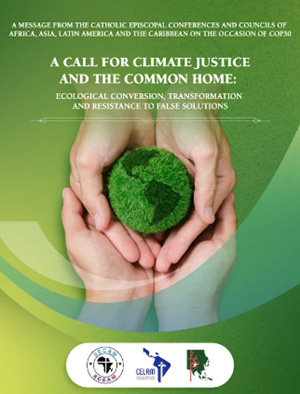
The 30th United Nations Climate Change Conference, or Conference of the Parties of the United Nations Framework Convention on Climate Change (UNFCCC) more commonly known as COP30, is to be held in Belém, Brazil, from 10 to 21 November 2025. Published below is the Executive Summary of a message from the Catholic Episcopal Conferences and Councils of Africa, Asia, Latin America and the Caribbean on the occasion of COP 30.


Ecological Conversion, Transformation and Resistance to False Solutions: A path of hope and ecological conversion
Inspired by both Laudato Si’ by Pope Francis and Pope Leo XIV’s call to live an integral ecology with justice, we call for a profound ecological conversion. Ten years since the publication of Laudato Siand the signing of the Paris Agreement, the countries of the world have not responded with the necessary urgency.

The Church will not remain silent. We will continue to raise our voice alongside science, civil society, and the most vulnerable, with truth and consistency, until justice is done.

I. Our demand

The climate crisis is an urgent reality, with global warming reaching 1.55°C in 2024. It is not just a technical problem: it is an existential issue of justice, dignity and care for our common home.

The science is clear: we must limit global warming to 1.5°C to avoid catastrophic effects. We must never abandon this goal. It is the Global South and future generations who are already suffering the consequences. We reject false solutions such as ‘green’ capitalism, technocracy, the commodification of nature, and extractivism, which perpetuate exploitation and injustice.

Instead, we demand:

  • Equity: Rich nations must pay their ecological debt with fair climate finance without further indebting the Global South, to recover losses and damages in Africa, Asia, Latin America and the Caribbean, and Oceania.
  • Justice: Promote economic degrowth and phase out fossil fuels, ending all new infrastructure and properly taxing those who have profited from them, ushering in a new era of governance that includes and prioritises the communities most affected by the climate and nature crises.
  • Protection: Defend indigenous peoples, ecosystems and impoverished communities; recognising the greater vulnerability of women, girls and new generations; and climate migration as a challenge of justice and human rights.

II. Commitments of the Church

The Church goes beyond words:

  • We will defend the most vulnerable in every decision about climate and nature.
  • We will educate in integral ecology and promote economies based on solidarity, the ‘happy sobriety’ of Laudato Si’ and the ‘Buen Vivir’ (‘Good Living’) of ancestral wisdom.
  • We will strengthen the intercontinental alliance between countries of the Global South to promote cooperation and solidarity.
  • We will monitor the results of the COPs through a Climate Justice Observatory.
  • We invite a historic coalition between actors from the Global North and South to face the crises in solidarity.

III. Call to action

We urge decision-makers to:

  • Fulfil the Paris Agreement and implement NDCs commensurate with the urgency of the climate crisis.
  • Put the common good above profit.
  • Transform the economic system towards a restorative model that prioritises people’s well-being and ensures conditions for sustainable life on the planet.
  • Promote climate and nature policies anchored in human rights.
  • Share and implement ethical, decentralised and appropriate technological solutions.
  • Achieve zero deforestation by 2030 and restore vital aquatic and terrestrial ecosystems.
  • Join forces to strengthen democratic multilateral processes, such as the Paris Agreement, and rebuild trust in cooperation and dialogue, uniting us as humanity, North and South, for the well-being of the planet.

Fruit of the collective discernment of the Churches of Africa, Asia, Latin America and the Caribbean, in preparation for COP30 in the continent of hope, invoking the inspiration of the Holy Spirit and in communion with the mission of the universal Church.

Transfigured into Christlike pilgrims of hope

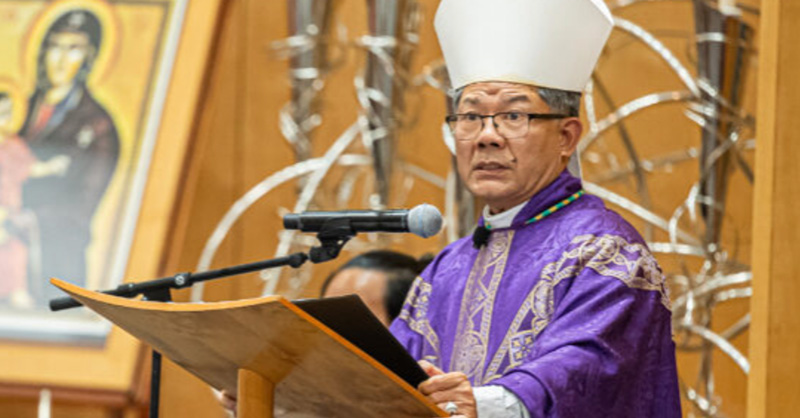
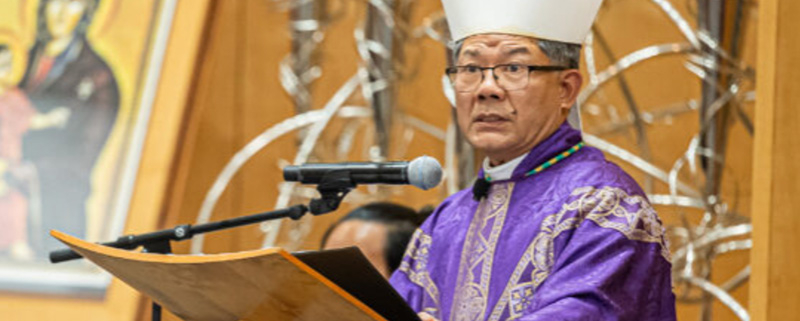
Bishop Vincent Long

The Solemnity of the Transfiguration was celebrated recently (August 6). With the Transfiguration also being the Gospel for the 2nd Sunday of Lent, it is opportune that we publish the Lenten Homily given by Bishop Vincent Long earlier this (Jubilee) Year.

Dear friends in Christ,

We live in a time of change. A process of what we call secularisation is taking hold of the church and the society. It is manifesting in many ways. It’s not just the critical shortage of priests and religious. Out of 100 Catholics only more or less 10 are practising. We are being reduced in number and impact, some would say an irrelevant minority; we are being exiled by the secular culture in which we live. We no longer enjoy the status we once had. The sexual abuse crisis has made sure of that. In many ways, the church is in uncharted territory.

We are like the Jews on their way to the promised land. They wanted to go back to Egypt when the journey became too hard. Yet the spirit of God called them forth and enabled them to march forward. This same spirit is with us today and he also encourages us to walk the unknown pathways ahead, with courage, with perseverance and with trust in the God of history.

We must not lose sight of the invitation to embark on a new adventure with God as he helps us to step out of the old and into the new. It is not in yearning for or holding on to the known and the familiar but in reimagining the future and venturing into the unknown chaos like the old Exodus that we shall find new life.

Scriptures on this second Sunday of Lent give us a poignant lesson in overcoming our fears and in living our lives with courage, vision, and hope. In the first reading from Genesis, Abram – a name which means great father – was called to undertake a journey of transformation: he would leave his familiar surroundings and people in order to become God’s instrument for a renewed creation. He would become Abraham, meaning “Father of the multitude.”

Abraham’s journey was a giant leap of faith, a leap into the unfamiliar, insecure, and vulnerable. He abandoned every form of human security and placed his trust solely in God. Abraham teaches us that faith is not synonymous with certitude, satisfaction, and fulfilment. So often, Christian faith has been distorted into prosperity, power, arrogance, violence, and scapegoating against the weak and vulnerable. The God of Abraham accompanies us on a journey of vulnerable trust, solidarity, and relational fidelity.

Thus, to follow this God is to relinquish the default position of self-interest and to walk the path of openness and compassion. Abraham’s journey of transformation through faith is also reflected in the story of the Transfiguration. It took place at a critical moment on the way to Jerusalem. The disciples had confronted the question “Who do you say that I am?” Jesus had revealed to them that he was going to be not a powerful Messiah of popular imagination but a suffering servant. In contrast with the powers that be, he had opted for the road less travelled, the unpopular pathway of humility, service, and selflessness. The disciples, however, were still transfixed on power and glory.

In the Transfiguration, they were given a moment of encouragement and an unmistakable message. “This is my Beloved Son, listen to him.” These words can be understood as an invitation to follow Jesus in his imminent suffering, passion, and death. The Transfiguration is meant to give them new courage to walk the painful journey ahead that would ultimately prove to be the litmus test of Christian discipleship.

The Gospel uses the word that is akin to metamorphosis to describe the Transfiguration. Perhaps that is what we the Body of Christ need to undergo as we shake off the old vestiges of the imperial Christendom with its penchant for triumphalism, power, pomp, and circumstance. Such relinquishment is required for us to rise to new ways of embodying the Gospel of powerlessness, simplicity, service, and compassion. Living the paschal pattern requires us to divest from the worldly accretions of power, influence, and affluence.

Our faith today is also being put to the test as that of Abraham and the disciples. Like them, we are challenged to overcome our fears and doubts. We are challenged to walk the journey of transformation by living out the demands of our pilgrim faith. This requires of us to have the courage to let go of the familiar and secure, the courage to launch into the deep, with everything that it entails.

As we gather in faith, we commit ourselves to move from the default conventional wisdom to the wisdom of God, based on self-emptying love. This was what Abraham learned from his journey into chaos and what disciples also learned from Jesus’ downward mobility model of behaviour. Let us deepen our relationship with him, reaffirm our commitment and pledge our unwavering fidelity to his way of the cross. Most of all, may we be inspired by the example of Abraham and of our Lord himself in turning our journey of despair to hope, and darkness to life-altering experience.

Bishop Vincent Long OFM Conv. is Bishop of Parramatta.