
Catholic Seminaries in Australia 1835-2023 (Part 8):
Vatican II and priestly formation
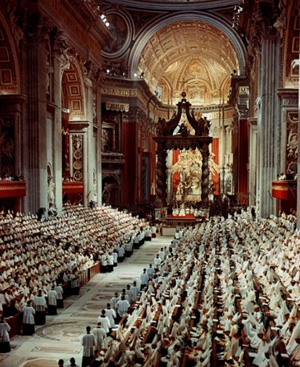
Second Vatican Council (1962-1965)
For some time now, The Swag has been publishing a series of articles submitted by Peter J. Wilkinson on the historical context of Australian Seminaries from 1835 – 2023. Part 8 in the series is published below: on Vatican II and priestly formation
When Pope John XXIII announced the Second Vatican Council on 25 January 1959 priestly formation was always going to be on the agenda. Priestly celibacy, however, was not so clear. During the 1950s the Holy See was aware of a crisis in the priesthood as well as the significant decline in priestly vocations in most of Europe and Latin America. In 1962 Pope John XXIII was also concerned about what to do with priests who had abandoned the priesthood and were seeking laicisation.
When the Council opened in October three commissions were assigned to prepare texts for the Discipline of Clergy, Religious Orders, Seminaries, and Catholic Schools. The first draft On the Life and Ministry of Priests was presented at the 1964 Third Period and spoke of the priest’s call to holiness and the ideal of chastity.
This immediately raised the issue of celibacy, and a majority of the bishops called for a substantive revision.
At the 1965 Fourth Period, the Central Preparatory Commission discussed a short schema On Lapsed Priests which assumed that most defections were related to celibacy and opened with an uncompromising reaffirmation of this discipline. However, the Commission overwhelmingly agreed that the issue of celibacy should not be raised publicly, and Pope John XXIII removed the schema.
The Commission did, however, look to widening the grounds for dispensations to allow priests who had left ministry to marry, for Pope John XXIII wanted these priests to be reconciled with the Church. Pope John was also open to other priests wishing to be married to do so with the blessing of the Church. On his deathbed on 3 June 1963, he made known his regret at not having resolved the issue.
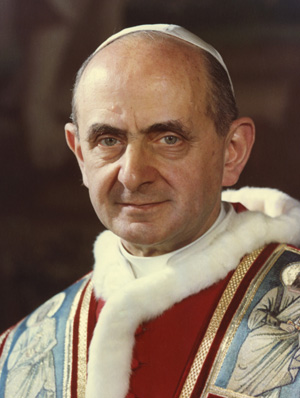
Pope Paul VI (1963 – 1978)
John XXIII’s successor, Pope Paul VI, was aware of Pope John’s deep concern for the priests who had left their priestly ministry to marry and his opposition to Conciliar discussion of celibacy. Paul VI also removed the subject of celibacy from discussion at Vatican II and in 1964, when increasing numbers of priests began seeking permission to marry, devised a ‘confidential’ judicial procedure to dispense them from celibacy and permit them to marry.
It was circulated to the Latin bishops in ‘strict secrecy’, but by 1965 had become widely known and many more priests began seeking the ‘Roman Rescript’ dispensation, as it was known at the time and later.
In November 1963, Paul VI published his Apostolic Letter Summi Dei Verbum commemorating the 400th Anniversary of the Council of Trent’s decrees on seminaries. He insisted that pastors and parents have a special duty to ‘direct their youth to the seminary ... as soon as they show clear signs of aspiring to the priesthood and are suited to it ... for only in this way will they be ... from the corruption of the world and enabled to cultivate the seed of the divine call in the most suitable surroundings’.
He said that seminary formation is ‘a complex work of physical, religious, moral and intellectual education’ and identified the indispensable signs of suitability for the priesthood as ‘right intention, solid piety, perfect purity of life, and sufficient knowledge’. But unless a bishop had ‘moral certitude’ that a candidate was suitable for priesthood, Paul VI said he should not ordain him.
The first draft on priestly formation De institutione Sacerdotali was presented to the Council’s full Assembly on 12 November 1964 but was sent back for amendment. The amended Decree Optatum totius was accepted and promulgated on 28 October 1965. It was the first of three decrees on the priesthood finalized in the Fourth Period, the others being Perfectae caritatis (Renewal of Religious Life) and Presbyterorum ordinis (Ministry and Life of Priests).
The Decree Optatum totius proclaimed the extreme importance of priestly formation but accepted that only ‘general rules’ (Ratio fundamentalis) could be legislated. It therefore called on the local Episcopal Conferences to draw up local programs for priestly formation (Ratio nationalis) suited to the time and place. They had to be approved by the Holy See, and revised at regular intervals.
The Council insisted that fostering vocations to the priesthood was a ‘community’ responsibility, including families, parishes, and teachers, with the bishop having a promotional role.
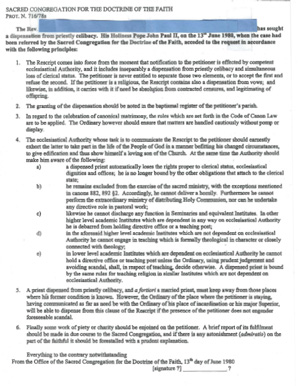
The ‘Roman Rescript’
The Council’s advice for minor seminaries was that the seminarians ‘should lead a life suited to the age, mentality, and developmental stage of young men, fully conform to the laws of a healthy psychology, be suitably involved in normal human activities, and have frequent contact with their families’. Their studies should be such that, should they leave the seminary, they will not be disadvantaged.
For major seminaries the Council insisted that the whole formation of these seminarians – who should have already completed courses in humanities and the sciences – should be preparation for the ministry of the Word, the ministry of worship and sanctification, and the ministry of a shepherd representing Christ before men. And every program must be joined with pastoral practice.
Seminary formators were to be selected from the best priests and painstakingly prepared. The bishop was to personally inspire them, and every priest should regard the seminary as ‘the heart of the diocese’. If individual dioceses were unable to have their own seminary, then regional or national seminaries should be established with statutes established by the relevant bishops and approved by the Holy See.
Spiritual formation was to be linked to doctrinal and pastoral training and no hardship of priestly life was to go unmentioned – especially celibacy, which was to be seen as a ‘precious gift’. Formation must also include the development of human maturity, attested by emotional stability, the ability to make considered decisions, a concern for justice, fidelity to one’s word, courtesy of manner, restraint, and kindliness in speech, and the entire program should be permeated with the cultivation of reverence, silence, and a concern for mutual help.
Other reforms proposed by Optatum totius were:
i) philosophy studies no longer to be limited to Thomistic Scholasticism;
ii) formation to adapt to contemporary pastoral needs, particularly those of the local church;
iii) training to be both doctrinal and pastoral;
iv) seminarians to use their own ingenuity;
v) Scripture to be the formative factor in the life of the student;
vi) seminaries to learn from modern sociology, psychology and pedagogy;
vii) seminarians to gain a better understanding of other Christian churches and non-Christian religions;
viii) formation to be ‘genuine and deep’;
ix) the ablest and best-prepared men to be chosen for formation work; and
x) sufficient time for an intense spiritual apprenticeship to be given to seminarians to weigh their vocation maturely.
The Episcopal Conferences were also asked to prepare special post-ordination programs for their younger priests providing gradual introduction to priestly life and helping them to renew and develop that life daily.
Paul VI: celibacy and defections
On Holy Thursday 1966 Paul VI referred to priests resigning from ministry as ‘new Judases’, but at the same time flagged a more lenient attitude to dispensations.
After the Council Paul VI came under intense pressure to re-address the issue of priestly celibacy because it was ‘troubling consciences, perplexing some priests and young aspirants, and causing alarm among many Catholics’. In June 1967 he published his Encyclical Sacerdotalis caelibatus, firmly upholding the traditional Latin Church discipline of obligatory celibacy, emphasising that it was a ‘special gift’, and that ‘the grace of leading a celibate life will be readily granted by God if those who share the priesthood humbly and earnestly ask for it’. He did admit, however, that ‘the difficulties and problems which make the observance of chastity very painful or quite impossible for some, spring from a type of priestly formation which is no longer completely adequate for the formation of a personality worthy of a man of God.
He insisted that the formation program had to take account of the candidate’s physical and psychological state in guiding and orienting him toward the priestly ideal and harmoniously coordinate grace and nature in those with the proper conditions and qualifications. These should be ascertained as soon as signs of a vocation are first indicated, not hastily or superficially, but carefully, with the assistance and aid of a doctor or a competent psychologist. A serious investigation of hereditary factors should also be undertaken, and where candidates are found to be unfit for physical, psychological or moral reasons, formators have a grave duty to quickly remove them from the path to priesthood. Moreover, there must be a preliminary trial period before the observance of celibacy becomes definitive and permanent, and only where there is moral certainty that the maturity of the candidate is sufficiently guaranteed, should he be permitted to take on the burden of priestly chastity’.
When Paul spoke of the ‘lamentable defections’ of priests who were seeking laicisation by means of the Roman Rescript, he blamed those bishops who had inadequately and imprudently assessed their candidate’s suitability. But where there were grave reasons to doubt the full freedom and responsibility of the defecting priests, Paul was prepared, after careful judicial examination, to declare them unsuited and grant a dispensation from celibacy, but only when no other solution could be found.
He advised all bishops to stay closely united to their priests and give them and those preparing for the priesthood the ‘best part of your hearts and pastoral care’ by watching over their seminary education and helping them remain faithful to their vocation and duties. He urged bishops to leave nothing undone to foster among their priests and seminarians the ideal of consecrated celibacy, nor neglect those who have strayed, no matter where their painful odyssey had led them. Paul VI also asked the lay faithful to help their priests, encourage them to overcome their difficulties with fidelity, show them charity, extend warm friendship, and show deep respect.
In August 1967 Paul VI renamed the Sacred Congregation of Seminaries and Universities as the Congregation for Catholic Education with jurisdiction over seminaries.


